
High-performance payment infrastructure/platform built for banks, payment networks, and payment operators — extending into the digital-asset era.

A Modern Real-Time Orchestration Engine for Digital Banking & Payments
Banks today remain constrained by legacy ESB and EAI platforms — systems never designed for the real-time, high-volume demands of modern digital payments. M^Dynamics Payment Hub breaks through these limitations with a high-performance, low-code, multi-rail orchestration engine that accelerates modernization and cuts time-to-market.
Powered by the M^Dynamics real-time OLTP platform, Payment Hub gives banks a unified foundation for end-to-end payment processing — integrating ISO 20022 and ISO 8583 rails, open API channels, digital banking systems, and external payment schemes into one interoperable layer.
Configure new payment rails and products without heavy custom development
One platform for mobile/internet banking, eWallet & QR, ATM, POS/xPOS/EFTPOS, API gateways, and third-party fintech services
Native support for ISO 20022, ISO 8583, and open API formats side by side
Built on the M^Dynamics platform for the throughput and latency modern digital payments demand
Legacy enterprise service buses slow down digital transformation instead of enabling it
Heavy coding and long release cycles stand in the way of new products
Disconnected channels increase operational risk
ISO 20022, ISO 8583, and proprietary formats overwhelm traditional middleware
Modern payment volumes demand mission-critical resilience, not best-effort availability
A transaction or message enters Payment Hub from any connected channel — mobile/internet banking, ATM, POS, an API gateway, or a fintech partner.
The hub validates and translates the message across formats (ISO 20022 ⇄ ISO 8583 ⇄ proprietary), so every channel and every rail speak the same language internally.
Low-code routing rules — configured, not hard-coded — decide where the transaction goes next: a core banking system, a payment scheme, or another connected service.
The transaction is processed in real time on the M^Dynamics OLTP platform, built for the volume and latency modern digital payments demand.
A response returns to the originating channel — with the same orchestration layer ready to add the next new rail or channel without touching what’s already live.
Low-code configuration turns new-rail launches into weeks, not year-long IT projects
One orchestration layer instead of fragmented, channel-by-channel integrations
ISO 20022 and ISO 8583 supported side by side, so migrations happen on your timeline, not the format’s
Built for the uptime real-time digital payments require, not batch-era assumptions

A High-Performance, Multi-Scheme Switching Engine for Banks & Fintechs
M^Dynamics Payment Switch & Gateway delivers real-time switching across ATM, POS, eCommerce, mobile banking, QR, and eWallet channels, plus domestic and international payment schemes. Built for today’s high-volume environment, it supports ISO 8583, ISO 20022 real-time payments, SWIFT MT/MX, and national payment systems such as G3/FAST.
Backed by deployments at Singapore’s largest payment operator and a leading global strategic technology and payment operator, it delivers enterprise-grade reliability with seamless scheme, host, and channel integrations.
ATM, POS, eCommerce, mobile banking, QR, and eWallet from one engine
Domestic and international payment schemes side by side
ISO 8583, ISO 20022 real-time payments, SWIFT MT/MX, and national systems like G3/FAST
Built for the volume and uptime national payment networks require
Can’t handle new channels — QR, APIs, eWallets — without heavy rework
Takes months on traditional switch architectures
Is difficult to maintain as networks and rules change
To support multiple message standards at once
From monolithic, single-threaded architectures
A transaction originates at any connected touchpoint — an ATM, POS terminal, eCommerce checkout, mobile app, QR code, or eWallet.
Payment Switch & Gateway authenticates and validates the transaction against configurable routing rules.
It routes the transaction to the correct scheme, host, or network — domestic or international — translating between ISO 8583, ISO 20022, and SWIFT MT/MX as needed.
If the primary host or issuer is unavailable, the switch can hand off to Stand-In Authorization to keep the transaction moving.
The response clears back through the switch to the originating channel in real time.
QR, eWallet, and API channels plug into the same switch instead of requiring a rebuild
Configurable rules replace hardcoded logic that gets riskier to touch over time
ISO 8583, ISO 20022, SWIFT MT/MX, and national systems like G3/FAST all handled natively
Architected against the single points of failure that come with monolithic switches

Real-Time Payment Continuity When Your Core Goes Down
In today’s fast-paced digital economy, uninterrupted payment processing is essential. Even a few minutes of downtime can disrupt customer transactions, impact merchant settlements, reduce revenue, and erode trust. M^Dynamics Stand-In Authorization eliminates this risk by maintaining real-time payment continuity whenever your core banking system becomes unavailable.
Built on the proven M^Dynamics real-time OLTP platform, this standalone solution keeps transactions flowing — authorizing, validating, and routing payments even during planned maintenance, system outages, or unexpected failures. It’s already deployed across both local and international banks, including major payment switch environments.
Most stand-in authorization solutions in the industry rely solely on static limits, authorizing transactions blindly on behalf of the core banking system. M^Dynamics goes further: it leverages critical, up-to-date data — account balances, customer information, and transaction history — to authorize payments based on actually available funds. That reduces financial exposure, strengthens risk controls, and keeps customers and merchants on a seamless, uninterrupted experience even during an outage.
Even the most advanced banking environments face risks — from planned core banking maintenance to unexpected system outages — that disrupt transaction flows and impact customer trust. When downtime occurs, the consequences extend well beyond inconvenience:
Stand-In Authorization continuously syncs with the core banking system — account balances, customer data, transaction history — while the core is available.
When the core system goes offline (planned maintenance or an unexpected failure), Stand-In Authorization automatically takes over authorization decisions.
Instead of falling back to static, pre-set limits, it decisions against the most recently synced data — so approvals reflect actual available funds, not blind assumptions.
Configurable risk rules apply throughout, so the institution controls exactly how much exposure it’s willing to accept during an outage.
Once the core system is restored, transactions processed during the outage reconcile back automatically, with no manual clean-up required.

Modernize Your Core — Without Disrupting What's Already Live
Legacy core banking systems weren’t built for today’s pace of change. M^Dynamics Digital X’formation Platform (DXP) is a smart middleware — an Intelligent Enterprise Application Integration (iEAI) layer — that lets banks and payment operators modernize channel by channel and system by system, without a disruptive core replacement.
DXP decouples requester systems (channels, apps, partners) from supplier systems (core banking, payment rails, third-party services). Instead of building a separate point-to-point integration for every requester-to-supplier pair — N × M connections — DXP reduces this to N + M: one connection per requester, one connection per supplier. A change to any one requester or supplier has little to no impact on everything else connected through it.
Checks that message fields (account number, phone number, ID number, name, etc.) are valid before they reach the core
Maps incoming message fields to outgoing message fields across systems that were never designed to talk to each other
Enriches data in flight, such as masking a credit card number
Routes messages by card prefix, BIN, or FI ID to the correct bank or financial institution
N requesters to one internal format, one internal format to M suppliers: N + M integrations instead of N × M
Supports emerging technologies and traditional/legacy systems side by side, so modernization doesn’t require ripping out what still works
Most core banking systems are monolithic and rigid, making it slow and costly to adapt to new business requirements
Gartner research has found organizations that leave technical debt unaddressed spend up to 40% more on maintenance than those managing it proactively
The skills needed to safely maintain decades-old core systems (COBOL, Assembly) are increasingly scarce, and fewer people are learning them today
Gartner projects 80% of technical debt will be architectural by 2026, meaning the risk in a new enhancement often isn’t the code change itself, but a system too tightly coupled to change safely
A 2023 survey of banking leaders found legacy infrastructure their #1 challenge (59%), ahead of both real-time data access (53%) and business agility (51%)
(These are third-party figures — verify each against the original Gartner/survey source before publishing, and cite them properly on the live page.)
DXP sits between requester systems (channels, digital apps, partner platforms) and supplier systems (core banking, payment rails, third-party services), as a decoupling layer between the two.
Incoming messages are validated field by field before they’re allowed to proceed.
DXP maps and enriches the message — translating and adapting formats between what the requester sends and what the supplier expects.
The message is routed to the correct destination using configurable rules (card prefix, BIN, FI ID, etc.).
Because every requester and supplier connects through DXP rather than directly to each other, adding, changing, or retiring any one system doesn’t ripple through the rest.
Phase in new channels and services around the existing core
N + M connections instead of N × M, so each new system added doesn’t multiply the ones before it
Decoupling means a change to one requester or supplier has little to no impact on the others, addressing the exact “will this break something else” fear that stalls modernization projects
Validation, mapping, and routing logic live in DXP’s configuration layer, not buried in code only a shrinking pool of legacy specialists can safely touch

Bank-Grade Digital Finance Treasury Platform
Connect traditional finance with stablecoin rails. Build, operate, and scale stablecoin payment flows through a secure orchestration layer designed for banks and financial institutions — without rebuilding your core systems.
1 orchestration layer · 7 core capabilities · API-first, ISO 20022 ready · 0 core system replacement
One infrastructure layer brings traditional and digital payment rails together:
Your existing payment, treasury, and core systems
The central point for workflows, approvals, balances, exceptions, and reconciliation
Connected external digital asset providers and rails
Funds received via established banking and payment channels
The orchestration layer runs on: fiat ⇄ stablecoin conversion, real-time balances, maker-checker approvals, and cross-border settlement
Orchestrate stablecoin workflows across payment systems, wallets, liquidity providers, and settlement partners through a central processing layer, with configurable routing, workflow controls, status tracking, and exception handling
Connect securely with institutional wallet and custody providers without introducing fragmented operational processes; manage wallet connectivity, client deposit addresses, deposits, withdrawals, and blockchain status from your existing environment
Connect fiat and stablecoin rails through integrated liquidity and conversion providers, supporting fiat-to-stablecoin and stablecoin-to-fiat flows with end-to-end visibility, approval controls, and settlement tracking
Real-time visibility across stablecoin and fiat positions from a consolidated treasury view: available balances, reserved funds, in-flight transactions, operating buffers, and prefunding requirements
Use stablecoins as an additional settlement rail for faster, more flexible cross-border flows, coordinated with traditional payout networks so beneficiaries receive funds through established channels
Bring blockchain activity, stablecoin conversions, fiat settlement, and payouts into one operational view, with automated matching, exception identification, and complete histories for reporting and auditability
Embed digital asset operations into your existing banking environment with institutional-grade controls: maker-checker workflows, role-based access, transaction limits, approvals, and complete audit trails
Most institutions treat digital assets as requiring an entirely new operating model, when the gap is really connectivity
Every new wallet or custody provider risks becoming its own silo, with its own workflow and reconciliation process
Treasury teams end up reconciling manually across rails and providers
Maker-checker, role-based access, and audit trails the bank already runs elsewhere often stop at the edge of stablecoin flows
A transaction — for example, a cross-border settlement — originates from the bank’s existing systems and enters the orchestration layer via API or ISO 20022 messaging.
Maker-checker approvals and role-based access controls apply before anything moves.
The layer routes the transaction across the right rail, converting fiat to stablecoin (or back) through connected liquidity and conversion providers.
Wallet, custody, and blockchain status are tracked via secure API/webhook connectivity throughout the transaction’s lifecycle.
Funds are paid out to beneficiaries, merchants, or counterparties through established banking and payment channels, with the full history reconciled and auditable end to end.
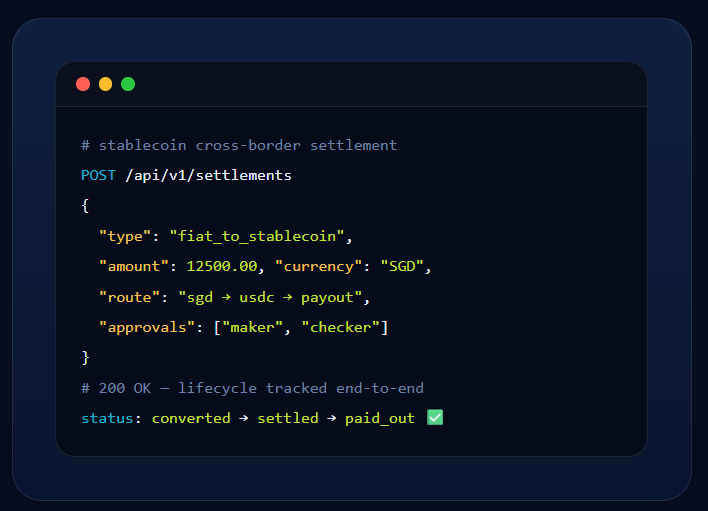
Faster settlement across corridors using stablecoin rails, with fiat-funded payouts to beneficiaries
Consolidated treasury services with real-time balances, buffers, and prefunding visibility
Stablecoin-funded settlement into local payment channels for merchants and counterparties
Local and international payout connectivity through banks, card networks, and payment providers
Connect via API, not a rebuild
Stablecoins as an additional rail alongside traditional payout networks
Instead of reconciling manually across providers
Maker-checker, role-based access, and audit trails built into the transaction lifecycle, not bolted on afterward
Operational controls, configurable approvals, and auditability built throughout the transaction lifecycle
Connect digital asset capabilities to existing banking, treasury, and payment infrastructure without replacing core systems
Track transactions from initiation through conversion, settlement, and payout from one consolidated view
Integrate with institutional custody providers, liquidity venues, stablecoin issuers, banks, and payment networks through a common orchestration layer
Centralize workflow management, exception handling, and reconciliation across multiple providers and rails
A modular infrastructure layer designed to support new stablecoin use cases, partners, currencies, and payment corridors as the business evolves
Our solutions are designed to support a wide range of organizations across the payment ecosystem.


Explore how MVI’s enterprise payment solutions can support your organization’s growth and digital transformation journey.
#09-14, Eunos Techpark, 60 Kaki Bukit Pl, Singapore 415979